In Other Words . . . So What if I Fall?

The Heart of Diety Never Takes His Eyes Off of Me . . .


“What if I stumble, what if I fall?
What if I lose my step and I make fools of us all?
Will the love continue when my walk
becomes a crawl?

What if I stumble, and what if I fall?”


Chorus from the song, "What if I stumble?"
Artist: DC Talk / Album: Intermission


It's a phenomenon I've noticed often in Contemporary Christian Music:
So much use of the word "I."

Why so much focus on ME? So what if I fall? It's a given that I will. And yes, His Great Love will go on even when my walk becomes a crawl.

See, there is not a soul since the beginning of the world that has not stumbled. We all fall and make fools of all mankind. It's our nature. Yet God sees each and every one. Every time. Everywhere. He's the Creator!

It is a land the Lord your God cares for; the eyes of the Lord our God are continually on it from the beginning of the year to its end.
- Deuteronomy 11:12

What land? What year? It was around the year 1400 B.C. It was the Land of Milk and Honey: The Promised Land. And in the context of this passage in Deuteronomy, the Israelites are being equipped to set out and possess the land. They did not yet physically control the land – their right to the territory hadn’t yet materialized. Yet they already seemed to have power over this land through eyes of faith.
I'm fairly certain they were not listening to DC Talk on thier IPods.
They were not worried about "falling."

And guess what? This same beautiful illustration is -- should be -- ours in 2009: God’s caring and attentive eyes are always looking upon us. And we - like the Israelites - can put our concerns and uneasiness into God’s hand of infinite grace and possess strength to face the yet-unseen future.

“The eyes of the Lord…” What precisely does that mean? Surely it is more than just Omniscience. I don't know for certain. But let’s just envision the delight and enchantment in the eyes of a loving and devoted parent as they watch their young child achieve something for the very first time. Let's say: walking! (Lots of stumbling and falling here.) Do you see in your mind's eye the deep love of God’s eyes as He watches His creation stumble and fall . . . and learn?

This looking-after is not delegated to some other heavenly creature. The Bible does not tell us that the eyes of the angels are watching over us. God Himself watches us! The heart of Deity looks after us! And he never stops watching after us. This special watch-care is unbroken. It’s continuous. This unwearied power of God toward His people has been uninterrupted since the creation of the world! No human effort, no lyricist, no gifted writer, no dramatist could ever sufficiently make plain or explain God’s watch-care over His own.

He watches each of us with personal interest and He absolutely sees us stumble and fall-- knowing full well that the ensuing bruises only teach us better how to walk when we get up and continue on . . . .

It’s time we switched to the flip side of all the songs and lyrics that focus on "I." We need to take an honest look at our eyes.

If God is ceaselessly and unwarily watching us, should not our eyes be upon Him? Constantly?!

Sad thing is I’m afraid we don’t even come close. We get caught up in our days -- setting our sights on the temporal and the frivolous – and we don’t look for Him or see Him at all. And that's when we ask,

"What if I stumble, what if I fall?"


~ Esthermay V. Bentley-Goossen
© 2009 The Heart of a Pastor's Wife


This installment of InOtherWords is hosted by Miriam on her blog, Miriam Pauline's Monolouge.

Problems or Pearls . . .

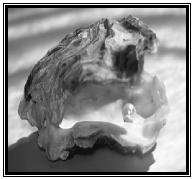
The little pearl oyster receiving accidentally into its shell a rough fragment of rock or sand tries in vain to expel the intruding and irritant substance and only suffers in the struggle until rasped and bleeding it gives up in agony and helplessness. Then a new force comes into play. From its peculiar physiological system the little mollusk sends forth a crystal fluid which covers and coats the rough piece of rock with a soft crystalline cushion and as this grows and hardens it becomes a beautiful pearl. It ceases to irritate and soothes and rests the wounded side of the little creature until the curse has become a blessing, and some days later the pearl fisher discovers the hidden treasure, opens the shell and takes forth a gem of purest luster and boundless value which is worn in the coronets of kings and adorns the highest rank and grandest occasions. So someday our sorrows, irritations and wrongs, having first been sweetened by the Holy Spirit into heavenly virtues, will become the jewels of an immortal crown and will shine in the diadem of Jesus and adorn our brow forever!

~ A. B. Simpson

A.B. Simpson’s words
are tender and poignant. The pearl oyster embodies so many human problems, sorrows, and emotional suffering. Like the oyster, we encounter “irritants,” but we have a tendency to try and avoid them. We’re human – it’s inborn.

Christian counselors will tell you that the basis of almost all mental illness is the tendency to avoid problems and the emotional suffering inherent in them. It was renowned physician Carl Jung who said, “Neurosis is always a substitute for legitimate suffering. “

The tragedy, of course, is that the substitute for our suffering ultimately becomes more painful that the original suffering we are trying to avoid! Does this explain why the wisest saints among us are often the people who endure pain rather than escape it? These saints are men and woman who are “acquainted with grief.” I believe this describes Job. How about our Savior Jesus Christ?

“He is despised and rejected of men; a man of sorrows,
and acquainted with grief."

~ Isaiah 53:3

“…yet learned he obedience by the things which he suffered.”
~ Hebrews 5:8

Are you trying to avoid
problems and the suffering that comes with them? Maybe you have several dozen problems today. If you listen to the voices around you, you’ll search for a substitute – an escape route. You’ll miss the fact that your problems are God-appointed – fashioned to stretch you and challenge you and deepen your walk with Him. Growth and wisdom come with each irritating-piece-of-sand-kind-of-a-problem. And what emerges is an exquisite gem of purest luster and boundless value!


- Esthermay V. Bentley-Goossen
© 2009 The Heart of a Pastor's Wife

In Other Words:

Find me Faithful. . .

“Mordecai understood that it is not failure that brings despair, but unfaithfulness and idleness.”
~Dorothy Patterson, Editor
Women’s Devotional Bible Devotion:
Service Through Providence

I recently celebrated a birthday; and like most people my age, I no longer count years. Not so much because the numbers is too high, but because the years don't seem to match-up with my successes. While I have succeeded at things that I had never set out to accomplish, I have also failed at many more.

Yet, despair is the very last word I would use to describe my life!

Faithfulness. Now there's a word I might use.

And let me think . . . idleness. Hmmmmm. . . . Here's a word with which I'm really not familiar. Perhaps Mordecai was on to something here. . .

I don't write this post to flatter myself. Not at all. I write because there is much truth to be found in Ms. Patterson's quote. It is not physical or earthy accomplishments -- or the lack of them -- that determine our state of mind. And I think most of us would have to agree: Faithfulness is a good thing. Faithfulness (i.e., faithfulness to God, our Creator) is a sustaining force that overcomes any physical or earthly pursuit.

Unfaithfulness in even its slightest form is hateful to God. Unfaithfulness often stems from unbelief; and unbelief destroys the soul. It hinders God's work in us. Which, of course, leads to despair!

But what is faithfulness to God?

Some think of faithfulness as simply living without lust and getting victory over sinful habits. Others think it means being constant in Bible reading, prayer, giving of tithes, and church attendance. Still others think of it as going about doing good, or keeping pure by avoiding all that is evil and wicked. But these things can never make us faithful to God. Never. These are works.

". . . not by works, so that no one can boast."
~ Ephesians 2:9

These are wonderful things indeed and are certainly commanded in God's Word - and we will do them if we are faithful. But they in themselves are not the essence of faithfulness. You see, faithfulness to God is impossible unless it springs from a trusting, believing heart!

"Take heed, brethren, lest there be in any of you an evil heart of unbelief, in departing from the living God."
~Hebrews 3:12

This verse is not written to unbelievers - but to Believers! The writer of Hebrews was saying, "You! Christians: Beware. Watch out. Make sure you don't have an evil heart of unbelief."

Unbelief must have been a problem back in 80 A.D. And unbelief is most definitely a problem in 2009 A.D. We are surrounded on all sides by unbelief in the world today. Our culture is steeped in skepticism and unbelief. And you'd be lying to yourself to think that unbelief does not also live in Christian circles.

I want to be the kind of Christian who does not need the reminder of Hebrews 3:12. I want to be the kind of Christian who believes God's Word is sufficient for every human need. I want to be the kind of Christian who believes that God's Word will guide and sustain me regardless of the future. I want to be the kind of Christian whose faithfulness knows nothing of idleness - neither idle talk nor idle thoughts. I want to be found faithful -- even in my failures.

"So then faith comes by hearing, and hearing by the word of God."
~ Romans 10:17

“Mordecai understood that it is not failure that brings despair, but unfaithfulness and idleness.”


And I understand that my faithfulness to God's Word
is my greatest insurance policy against despair. . . .


~ Esthermay V. Bentley-Goossen
© 2009 The Heart of a Pastor's Wife


This installment of InOtherWords is hosted by Patricia on her blog, Typing One Handed.